Publications

Research Papers

Peer-reviewable work from our labs, published on arXiv. Every paper below is summarised in plain language first — what we found and why it matters — with the full abstract and the paper itself one click away. For applied write-ups and benchmarks, see Reports.

2026

September 9, 2026

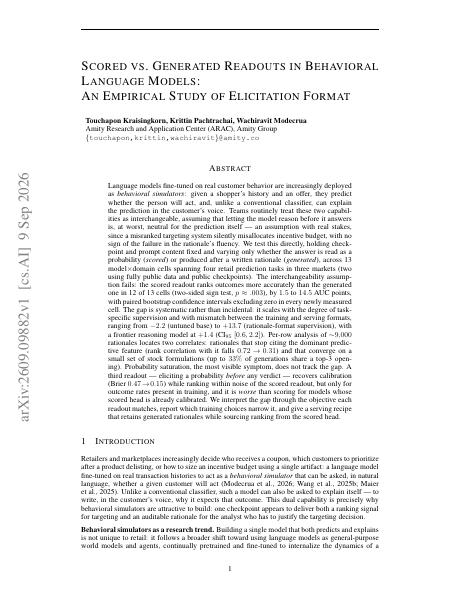
Scored vs. Generated Readouts in Behavioral Language Models: An Empirical Study of Elicitation Format

Up to +14.5 AUC pointsfrom changing how you ask, not what you ask

When you ask an AI to predict what a customer will do, how you ask changes the answer. Reading the score the model assigns internally turns out to rank outcomes more accurately than asking it to write out its reasoning and then answer.

Technical abstract & authors

Language models fine-tuned on customer behavior can predict outcomes and generate explanations, but these readouts are often treated as interchangeable. Holding model checkpoint and prompt content fixed, we compare probabilities obtained by scoring answer tokens with predictions generated after a written rationale. Across 13 model-domain cells covering four retail tasks in three markets, including two using fully public data and checkpoints, the scored readout ranks outcomes more accurately in 12 of 13 cells (two-sided sign test, p approximately 0.003), by 1.5 to 14.5 points in area under the receiver operating characteristic curve (AUC). We interpret these differences through the objectives matched by each readout, identify training choices that narrow the gap, and propose retaining generated rationales while sourcing ranking from the scored head.
Touchapon Kraisingkorn, Krittin Pachtrachai, Wachiravit Modecrua

July 8, 2026

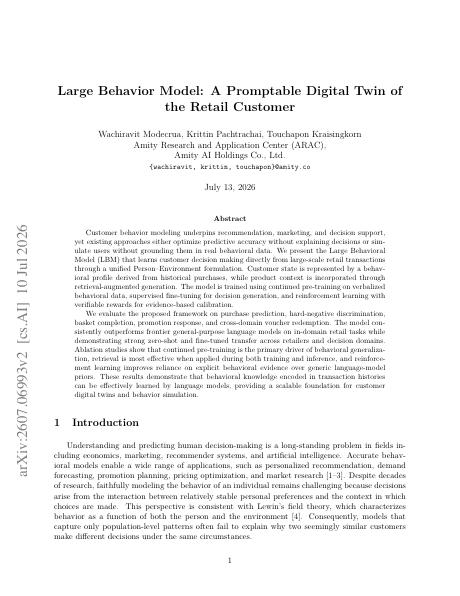
Large Behavior Model: A Promptable Digital Twin of the Retail Customer

Beats frontier LLMs on retail tasksand transfers to retailers it was never trained on

A language model trained directly on real retail transaction histories, so it can stand in for a customer. You can ask it what someone is likely to buy next, how they would respond to a promotion, or what is missing from their basket — and it explains its answer from that person’s actual purchase history.

Technical abstract & authors

Customer behavior modeling underpins recommendation, marketing, and decision support, yet existing approaches either optimize predictive accuracy without explaining decisions or simulate users without grounding them in real behavioral data. We present the Large Behavioral Model (LBM) that learns customer decision making directly from large-scale retail transactions through a unified Person-Environment formulation. Customer state is represented by a behavioral profile derived from historical purchases, while product context is incorporated through retrieval-augmented generation. We evaluate the proposed framework on purchase prediction, hard-negative discrimination, basket completion, promotion response, and cross-domain voucher redemption. The model consistently outperforms frontier general-purpose language models on in-domain retail tasks while demonstrating strong zero-shot and fine-tuned transfer across retailers and decision domains.

Wachiravit Modecrua, Krittin Pachtrachai, Touchapon Kraisingkorn

July 7, 2026

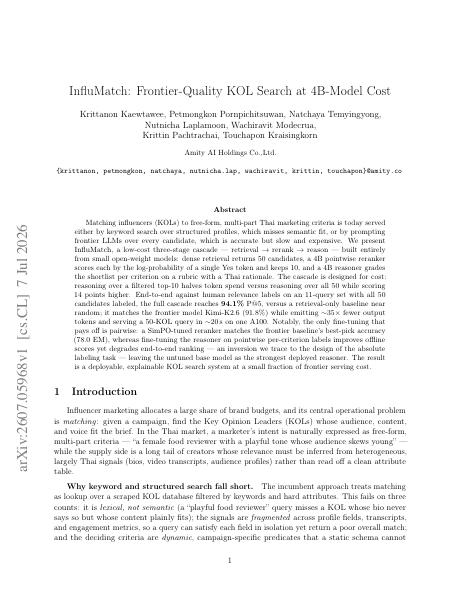
InfluMatch: Frontier-Quality KOL Search at 4B-Model Cost

94.1% top-5 accuracyat roughly 35x fewer output tokens than a frontier model

Picking the right influencer for a Thai marketing brief normally means one of two bad options: keyword search, which is cheap but misses what the brief actually asks for, or running a frontier model over every candidate, which works but is slow and expensive. This builds a three-stage funnel out of small open models that narrows the field, then reasons carefully only about the finalists.

Technical abstract & authors

Matching influencers (KOLs) to free-form, multi-part Thai marketing criteria is today served either by keyword search over structured profiles, which misses semantic fit, or by prompting frontier LLMs over every candidate, which is accurate but slow and expensive. We present InfluMatch, a low-cost three-stage cascade (retrieval, rerank, reason) built entirely from small open-weight models. End-to-end against human relevance labels on an 11-query set with all 50 candidates labeled, the full cascade reaches 94.1% P@5, versus a retrieval-only baseline near random; it matches the frontier model Kimi-K2.6 (91.8%) while emitting roughly 35 times fewer output tokens and serving a 50-KOL query in about 20 seconds on one A100. Notably, the only fine-tuning that pays off is pairwise, leaving the untuned base model as the strongest deployed reasoner.

Krittanon Kaewtawee, Petmongkon Pornpichitsuwan, Natchaya Temyingyong, Nutnicha Laplamoon, Wachiravit Modecrua, Krittin Pachtrachai, Touchapon Kraisingkorn

April 3, 2026

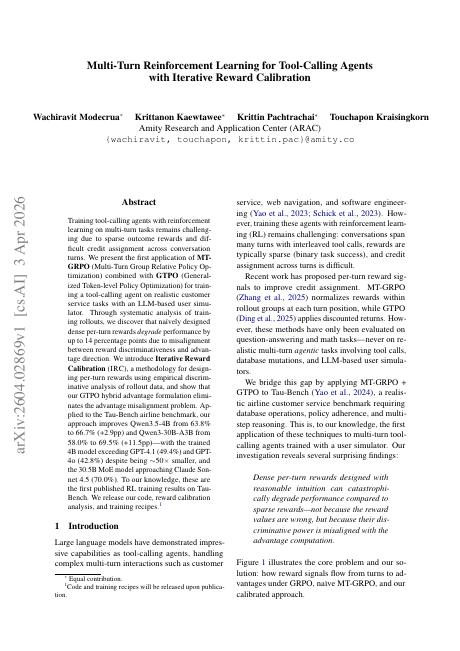
Multi-Turn Reinforcement Learning for Tool-Calling Agents with Iterative Reward Calibration

A 4B model beating GPT-4.1on Tau-Bench, at roughly 50x smaller

Training an AI agent that uses tools across a long customer-service conversation is hard, because you only find out whether it succeeded at the very end. Scoring each individual turn seems like the fix, but done naively it makes the agent worse. This work shows how to design those per-turn scores so they help rather than hurt.

Technical abstract & authors

Training tool-calling agents with reinforcement learning on multi-turn tasks remains challenging due to sparse outcome rewards and difficult credit assignment across conversation turns. We present the first application of MT-GRPO combined with GTPO for training a tool-calling agent on realistic customer service tasks with an LLM-based user simulator. Through systematic analysis of training rollouts, we discover that naively designed dense per-turn rewards degrade performance by up to 14 percentage points due to misalignment between reward discriminativeness and advantage direction. Applied to the Tau-Bench airline benchmark, our approach improves Qwen3.5-4B from 63.8 to 66.7 percent and Qwen3-30B-A3B from 58.0 to 69.5 percent, with the trained 4B model exceeding GPT-4.1 (49.4 percent) and GPT-4o (42.8 percent) despite being 50 times smaller. To our knowledge, these are the first published RL training results on Tau-Bench.

Wachiravit Modecrua, Krittanon Kaewtawee, Krittin Pachtrachai, Touchapon Kraisingkorn

January 26, 2026

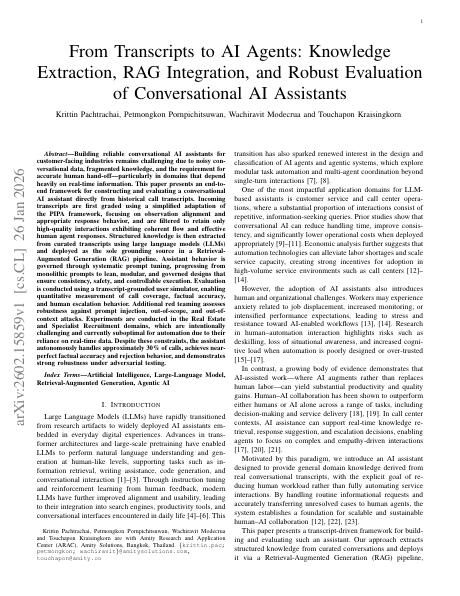
From Transcripts to AI Agents: Knowledge Extraction, RAG Integration, and Robust Evaluation of Conversational AI Assistants

~30% of calls handled on its ownwith near-perfect factual accuracy and clean human hand-off

Rather than hand-writing a knowledge base, this builds a working phone assistant straight out of a company’s past call recordings: keep only the calls where the human agent did a good job, pull the knowledge out of those, and let that be the assistant’s only source of truth.

Technical abstract & authors

Building reliable conversational AI assistants for customer-facing industries remains challenging due to noisy conversational data, fragmented knowledge, and the requirement for accurate human hand-off. This paper presents an end-to-end framework for constructing and evaluating a conversational AI assistant directly from historical call transcripts. Incoming transcripts are graded using a simplified adaptation of the PIPA framework and filtered to retain only high-quality interactions. Structured knowledge is then extracted using LLMs and deployed as the sole grounding source in a Retrieval-Augmented Generation pipeline. Evaluation is conducted using a transcript-grounded user simulator, with additional red teaming against prompt injection, out-of-scope, and out-of-context attacks. Despite challenging constraints, the assistant autonomously handles approximately 30 percent of calls, achieves near-perfect factual accuracy and rejection behavior, and demonstrates strong robustness under adversarial testing.

Krittin Pachtrachai, Petmongkon Pornpichitsuwan, Wachiravit Modecrua, Touchapon Kraisingkorn

2025

December 30, 2025

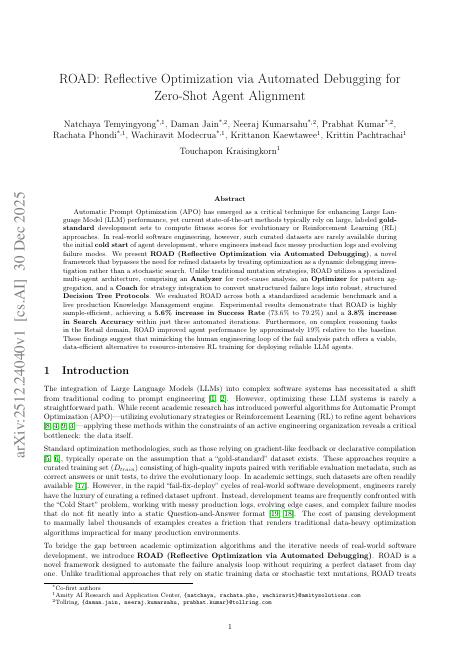
ROAD: Reflective Optimization via Automated Debugging for Zero-Shot Agent Alignment

73.6% to 79.2% in three passeswith no hand-labeled dataset required

Automatic prompt-tuning methods normally need a large, carefully labeled test set — exactly the thing you do not have when you are starting out. ROAD skips it by treating optimization the way an engineer treats a bug: read the failure logs, work out the root cause, spot the pattern, patch the prompt, repeat.

Technical abstract & authors

Automatic Prompt Optimization has emerged as a critical technique for enhancing LLM performance, yet current state-of-the-art methods typically rely on large, labeled gold-standard development sets. In real-world software engineering, such curated datasets are rarely available during the initial cold start of agent development. We present ROAD, a framework that bypasses the need for refined datasets by treating optimization as a dynamic debugging investigation rather than a stochastic search. ROAD utilizes a specialized multi-agent architecture, comprising an Analyzer for root-cause analysis, an Optimizer for pattern aggregation, and a Coach for strategy integration, to convert unstructured failure logs into robust, structured Decision Tree Protocols. ROAD achieves a 5.6 percent increase in success rate (73.6 to 79.2 percent) within just three automated iterations, and improved agent performance by approximately 19 percent relative to baseline on complex retail reasoning tasks.

Natchaya Temyingyong, Daman Jain, Neeraj Kumarsahu, Prabhat Kumar, Rachata Phondi, Wachiravit Modecrua, Krittanon Kaewtawee, Krittin Pachtrachai, Touchapon Kraisingkorn

September 5, 2025

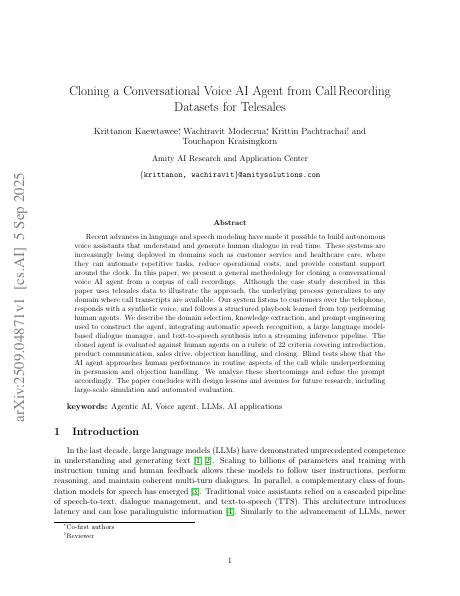
Cloning a Conversational Voice AI Agent from Call Recording Datasets for Telesales

Judged against humans on 22 criteriamatching them on routine calls, behind on persuasion

A recipe for building a phone agent that learns its playbook from recordings of a company’s best human agents, then handles live calls in a synthetic voice — listening, answering, and following the same structure the top performers used.

Technical abstract & authors

Recent advances in language and speech modelling have made it possible to build autonomous voice assistants that understand and generate human dialogue in real time. In this paper, we present a general methodology for cloning a conversational voice AI agent from a corpus of call recordings. Although the case study uses telesales data, the underlying process generalizes to any domain where call transcripts are available. We describe the domain selection, knowledge extraction, and prompt engineering used to construct the agent, integrating automatic speech recognition, an LLM-based dialogue manager, and text to speech synthesis into a streaming inference pipeline. The cloned agent is evaluated against human agents on a rubric of 22 criteria covering introduction, product communication, sales drive, objection handling, and closing. Blind tests show that the AI agent approaches human performance in routine aspects of the call while underperforming in persuasion and objection handling.

Krittanon Kaewtawee, Wachiravit Modecrua, Krittin Pachtrachai, Touchapon Kraisingkorn

Collaborate and partner with our AI Research & Application Center

Partner with Amity’s AI Lab to co-develop AI solutions through collaboration opportunities.

Collaborate with Us