
Shifting from traditional advertising to KOL-led marketing
TV ads are taking a backseat as people spend more time on their phones. In fact, 97% of Gen Z use social media to guide their buying choices. This shift has pushed brands to go digital, moving away from traditional ads toward KOL-driven marketing. Key Opinion Leaders, much like "Influencers," are experts in their specific fields who can build strong credibility and trust with their audiences.
Shopify reports that KOLs exert 36% more influence on consumers than direct brand advertising. Their secret lies in the strong, personal bonds they build with followers online. When customers see several KOLs using a product in real life, they can compare and judge for themselves, leading to higher trust in the creator than in the brand's corporate message. Even though the brand still dictates the overall image, it's the KOL who makes that information feel friendly, authentic, and easy to connect with.
However, the true challenge lies in identifying the perfect KOL among a myriad of factors. This requires meticulous screening of followers, content style, past collaborations, and, most importantly, ensuring no adverse impact on the brand's reputation.
That's why Influmatch AI was created—as a smart solution for precise KOL selection. It reduces manual complexity while ensuring consistent accuracy and providing transparent reasoning for every decision made.
What is Influmatch?
Influmatch AI is an advanced KOL-product matching platform that replicates expert decision-making processes. By digitizing insights gained from expert interviews into an automated workflow, the platform allows users to simply input product or campaign details to instantly receive a ranked shortlist of KOLs, complete with suitability scores and clear justifications. Influmatch AI is designed to eliminate the burden of manual browsing and standardize decision-making—removing personal bias to ensure every selection is transparent, measurable, and perfectly aligned with campaign goals.
System Architecture of Influmatch AI
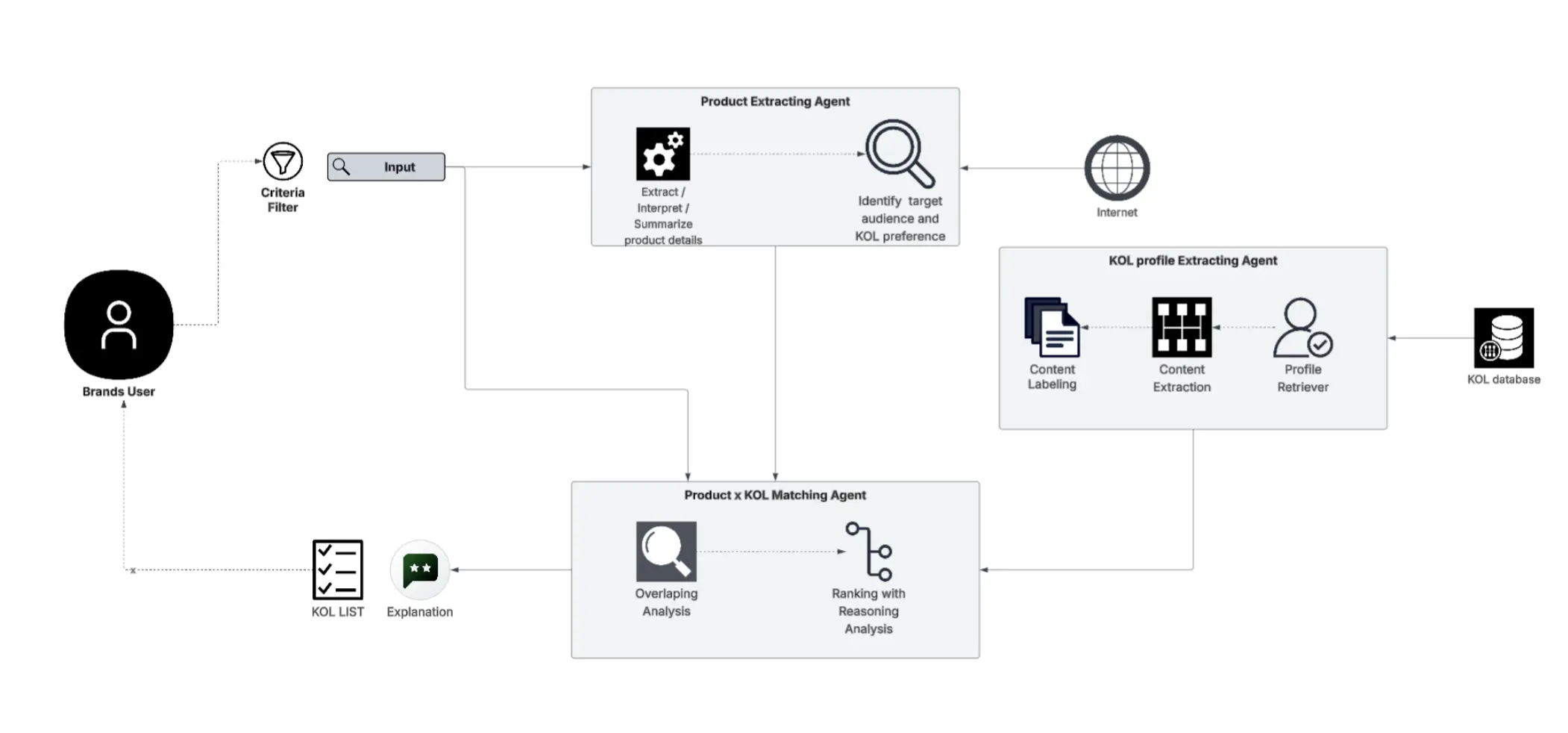
Influmatch AI is powered by three core AI Agents under a modular architecture. This modular design clearly decouples data extraction from the processing logic, facilitating easier maintenance, rapid debugging, and transparency throughout every stage of the workflow. The details are as follows:
1. Product Extracting Agent: Responsible for transforming user-provided data into a structured schema. The agent analyzes product information and performs supplemental web searches to ensure the product profile is as comprehensive and complete as possible.
2. KOL Profile Extracting Agent: Responsible for converting individual KOL data into a structured schema by extracting deep insights from various social media signals, including:
- Demographics: Basic information such as location and language cues.
- Content Analysis: Evaluation of recent content and core content themes.
- Engagement & Activity Statistics: Metrics such as follower count, likes, comments, and posting frequency.
3. Matching Agent: Integrates product data and KOL profiles to perform matching based on predefined criteria. It handles ranking, scoring, and generating logical justifications to deliver the final curated results.
The system workflow begins with two primary types of input data:
1. Brief: Product or campaign details provided by the user, including KOL preferences. If not provided, the system will automatically rank candidates based on the context of the available brief.
2. KOL Candidate: The total pool of KOLs within the internal database that the system evaluates as the source for selection.
The final output provides a strategic ranking of the most suitable KOLs, featuring in-depth analysis for each profile as follows:
1. Fit score breakdown across key dimensions: Evaluation across various key metrics, such as content relevance, audience alignment, communication tone consistency, and brand safety or risk assessment.
2. Constraint status: A clear status indicating whether each candidate meets the specific requirements of the brief.
3. Explanations: Comprehensive explanations detailing the logic and evidence behind every decision.
Product Extracting Agent
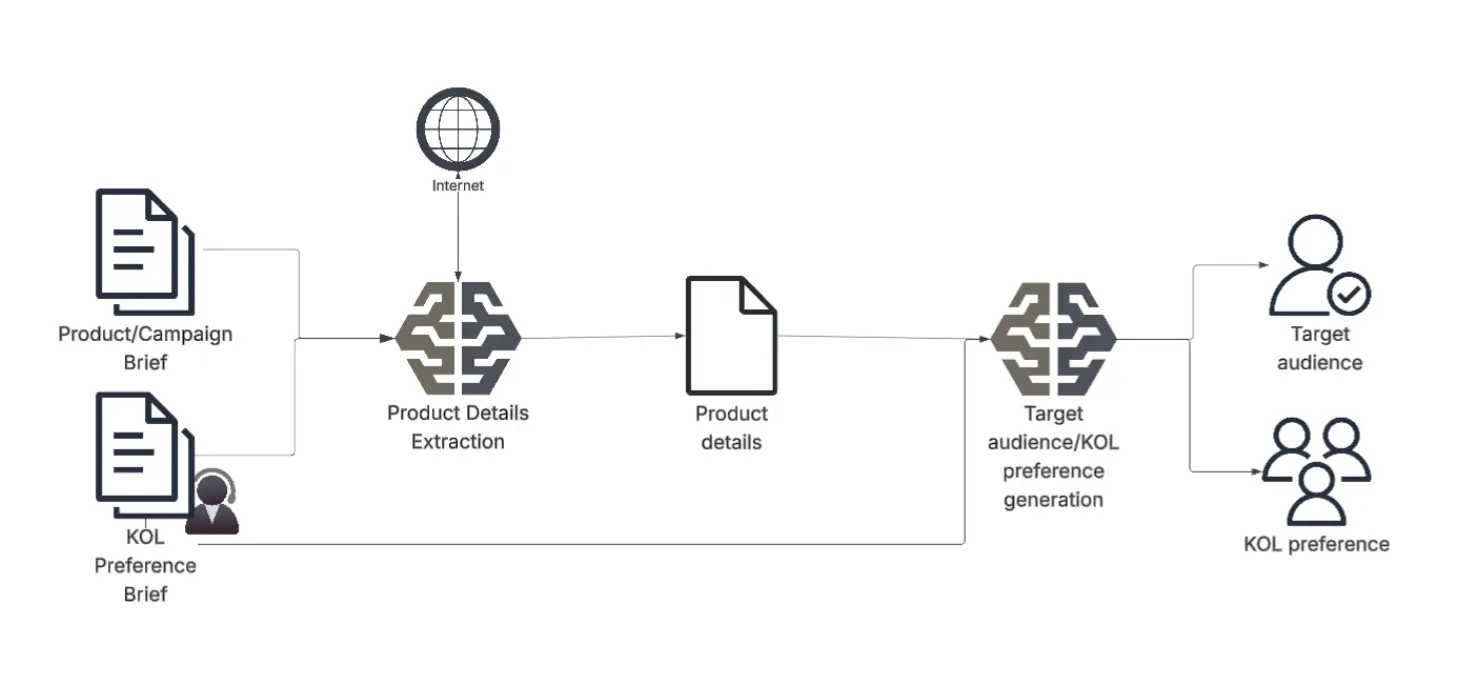
Beyond structuring the brief, the Product Extracting Agent is responsible for enriching it by gathering supplemental data—such as product positioning, category cues, and common use cases—to ensure a comprehensive profile even from minimal input.
The workflow of this agent consists of two key stages:
1. Product Detail Extraction: Standardizes the product information from the brief and retrieves supplemental web data if the initial input is insufficient. This stage produces a refined and more comprehensive product profile, serving as a solid foundation for the subsequent steps.
2. Target Audience and KOL Preference Generation: Based on the enriched product details, the agent infers potential target audiences and generates KOL preference profile. If the user has already specified KOL preference brief, the agent integrates them as core constraints or baseline data. If not provided, it autonomously derives these preferences from the product context. The final output is a clearly defined target audience profile and KOL preference profile.
KOL Profile Extracting Agent
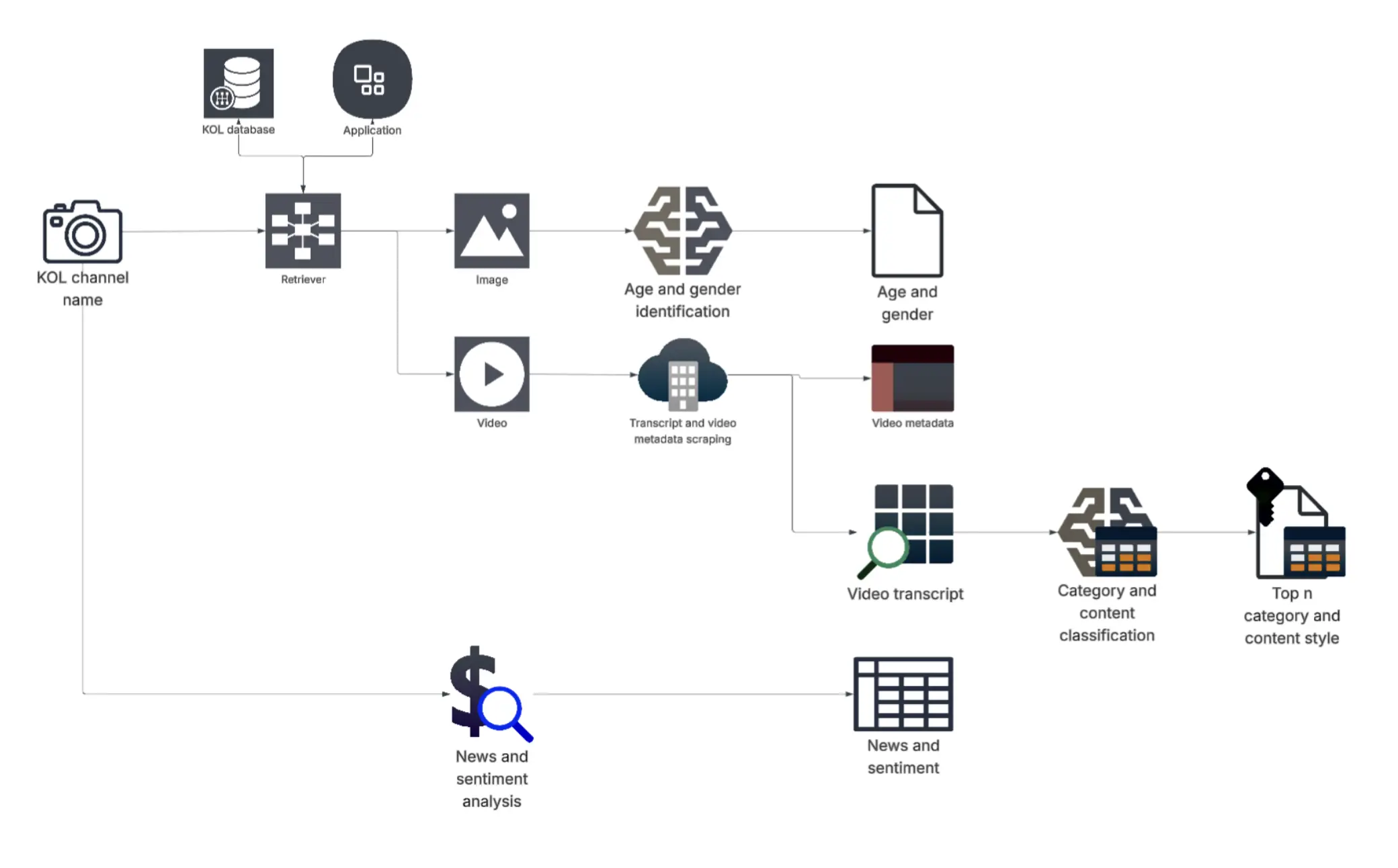
This agent is responsible for converting initial KOL data, such as account names or profile links, into a comprehensive structured schema by aggregating recent trends and content style summaries.
This agent operates through a five-stage process:
1. Profile Photo Analysis: Checks for existing KOL data in the internal database. If unavailable, the system retrieves the profile image from TikTok and analyzes it to estimate gender and age range.
2. Video and Transcript Retrieval: Collects TikTok video data within a specified timeframe (e.g., the last 30 days), including metrics such as view counts, comments, and publication dates.
3. AI-Based Content Classification (Category and Style): Analyzes video transcripts to identify content types and styles. It ranks the top 3 most likely categories and calculates their percentage distribution to provide a clear overview of the creator's core content.
4. News and Sentiment Analysis (Risk Signal): Monitors recent news mentions of the KOL to assess reputational risks. By classifying sentiment as positive, neutral, or negative, it allows brands to instantly identify significant events or ongoing controversies.
5. Profile Statistics Aggregation and Feature Construction: Aggregates all collected data into standardized features. This includes calculating statistical averages, such as engagement rates over specific periods (7/14/30 days), and mapping content posting behaviors across different days and times.
Matching Agent
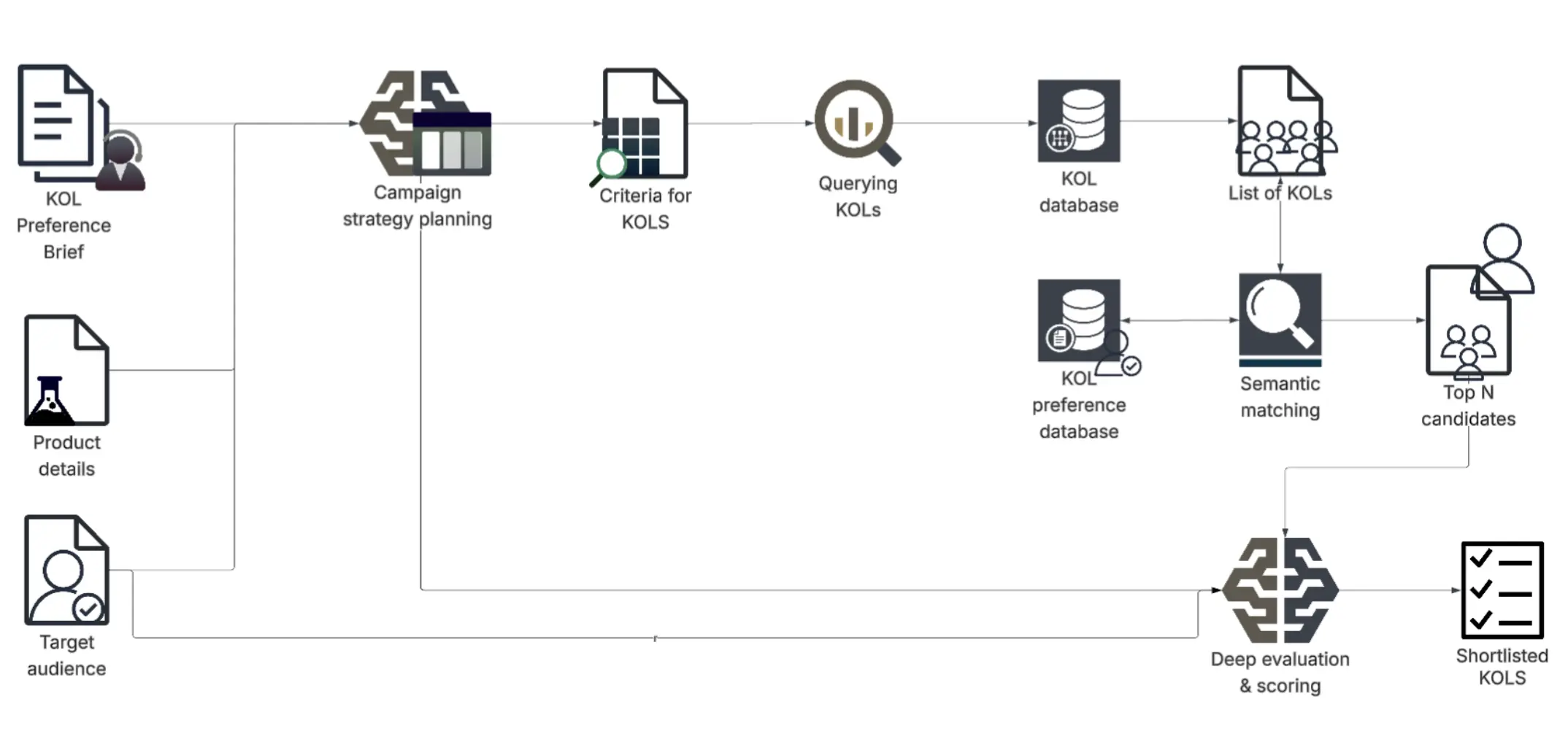
The Product x KOL Matching Agent is responsible for analyzing the brief to ranked, explainable shortlist of KOLs. It operates through three core mechanisms: narrowing down the candidate list for precision, optimizing the distribution of KOL Tiers to align with campaign constraints, and calculating suitability scores (0-100) supported by LLM-generated reasoning to produce the final ranked list.
This agent operates through a five-stage process:
1. KOL Preference Embedding: Processes the KOL attributes received from the previous agent into vector embeddings for semantic retrieval.
2. Campaign Strategy Planning: Systematically organizes the analyzed data into a campaign plan. This includes defining clear KOL Tiers (e.g., Mega, Macro, Micro, and Nano), determining number of KOLs per tier, and allocating budgets per tier. It also specifies inferred KOL demographic preferences with a rationale for the proposed plan to ensure alignment with both campaign constraints and budget structure.
3. Overlapping and Ranking with Reasoning Analysis: The system concurrently matches KOLs across all tiers through a parallelized workflow:
- Semantic Search (Tier-Filtered Retrieval): Filters KOL vector embeddings based on the defined tiers. It then applies Cosine Similarity to retrieve the most semantically relevant candidates within each tier (defaulting to the top 50), and fetching their profiles and content styles for in-depth evaluation.
- AI Reasoning and Structured Evaluation: All candidates are evaluated using parallel processing to control latency and context length. The System analyzes and returns structured results, including:
- KOL Name: Identity and profile data.
- Binary Selection Decision: A "Pass/Fail" determination.
- Criterion-level Evaluations: such as Scores and concise explanations across 8 key criteria for end-to-end transparency.
- Overall Justification: explaining why the KOL was or was not selected.
- Conflict-of-Interest Notes: Alerts regarding potential conflicts, such as previous mentions of competitors or misaligned brand associations.
- Weighted Scoring and Selection: Upon receiving the reasoned data, the system calculates a final Weighted Score by calculating LLM-produced score for criterion with corresponding criterion weight. Within each tier, the system filters for qualified candidates and ranks them in descending order to generate the Shortlisted KOLs based on the campaign plan. Candidates who meet the threshold but fall outside the primary count are categorized as Alternative Options.
4. Tier Aggregation and Logging: In the final stage, the system consolidates results from all tiers into a comprehensive report. It logs operational metadata, such as total token usage and processing latency, to facilitate auditing, cost-effectiveness evaluation, and overall system performance analysis.
Result
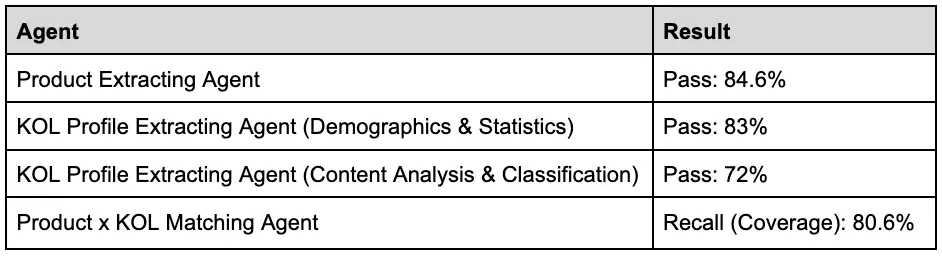
Test Results Summary Across 3 Agents, featuring detailed insights and key metrics as follows:
1. Product Extracting Agent: The agent demonstrated high operational efficiency with a score of 84.6%. The majority of extracted data—including product details, target audiences, and KOL preference signals—was delivered in a ready-to-use format. Only a small fraction of cases required additional context to achieve optimal completeness.
2. KOL Profile Extracting Agent: In terms of Demographics & Statistics (e.g., follower counts and audience data), the system performed impressively with a score of 83%. However, Content Analysis & Classification—which involves transcribing videos to identify categories and styles—yielded a score of 72%. This suggests that while the system excels at processing explicit metadata and numerical data, analyzing short-form TikTok content remains challenging due to the inherently high level of context ambiguity.
3. Product x KOL Matching Agent: Using human decision-making as the baseline for selection alignment, the system achieved a highly satisfactory correlation. The results showed an average coverage score of 80.6% compared to human judgment.
Conclusions
In an era where marketing speed is the ultimate deadline, Influmatch AI proves that we no longer need to compromise "precision" for "velocity." Our Multi-agent architecture is meticulously engineered to perform the work of an entire expert team—from deconstructing product briefs to pinpointing the ideal KOLs across every tier.
While traditional KOL selection relies on intuition or manual profile scouting, Influmatch transcends those limitations with a 3-Agent intelligent architecture, achieving an 80.6% Recall (Coverage) rate compared to human judgment. This result is not achieved through weeks of manual labor, but through a Reasoning-based Scoring system that truly understands the underlying logic of brand requirements.
Ultimately, Influmatch is the shortest path to transforming a "brief" into a "tangible strategy." It serves as the bridge connecting vast social media data with concrete business objectives. Although our current analysis is primarily text-based, the results prove a massive reduction in manual effort while providing "transparent and explainable" recommendations.
The era of guesswork and gut feelings in KOL selection is over. With Influmatch, we don't just provide a list—we deliver an intelligent, scalable selection system ready to elevate your campaigns to an entirely new standard.
Collaborate and partner with our AI Lab at Amity Solutions here
![Agentic AI for Deep Data Analysis [White Paper]](/arac/cdn/688c8528706936e3d80ead47_6874de15bdde1d9ca56cf2b3_-White-Paper-Agentic-AI-for-Deep-Data-Analysis.webp)